

Apr 08,2024
Temu Opens Three New Sites Again, Reaching 53 Countries
In today's interconnected global economy, the movement of goods from origin to destination is an intricate dance of planning, execution, and coordination. At the heart of this complex choreography lies the logistics management system (LMS) – a critical technological framework designed to streamline and optimize these processes. Far beyond simple tracking, a modern LMS serves as the digital brain of freight forwarding operations and wider supply chain collaboration, transforming traditional, fragmented workflows into cohesive, efficient, and transparent journeys.
Understanding the Core Function: What Problem Does an LMS Solve?
Historically, logistics operations have been plagued by manual processes, information silos, and reactive problem-solving. This often led to delays, miscommunications, and a lack of real-time visibility into the status of shipments. The fundamental problem an LMS addresses is the inherent complexity and fragmentation of the global supply chain, offering a unified platform for managing the flow of goods and associated information.
The Challenge of Fragmented Operations
Consider a cross-border shipment: it involves multiple carriers, customs agents, warehouses, and consignees across different time zones and regulatory environments. Without a centralized system, managing these disparate entities and data points becomes an administrative nightmare, hindering logistics digitalization efforts. Each party might use its own communication methods and data formats, creating significant reconciliation challenges.
The Impact on Operational Efficiency
Such fragmentation directly impacts operational efficiency. Delays in information exchange can lead to missed deadlines, increased demurrage charges, and frustrated customers. Manual data entry and reconciliation are prone to errors and consume valuable staff time, diverting resources from more strategic tasks. Furthermore, the absence of a holistic view makes it difficult to identify bottlenecks or areas for improvement, impeding overall performance optimization.

Key Pillars of a Modern Logistics Management System
A sophisticated LMS is built upon several core capabilities that collectively elevate logistics visibility, enhance collaboration, and drive operational excellence. These pillars directly address the challenges of traditional logistics.
1. End-to-End Milestone Visibility: Seeing the Unseen
The Problem: In traditional logistics, knowing the precise status of a shipment at any given moment is often elusive. Information might be scattered across various carrier portals, email threads, or phone calls, making it impossible to ascertain the exact location or stage of a consignment without significant manual effort. This lack of logistics visualization creates uncertainty and hinders proactive decision-making.
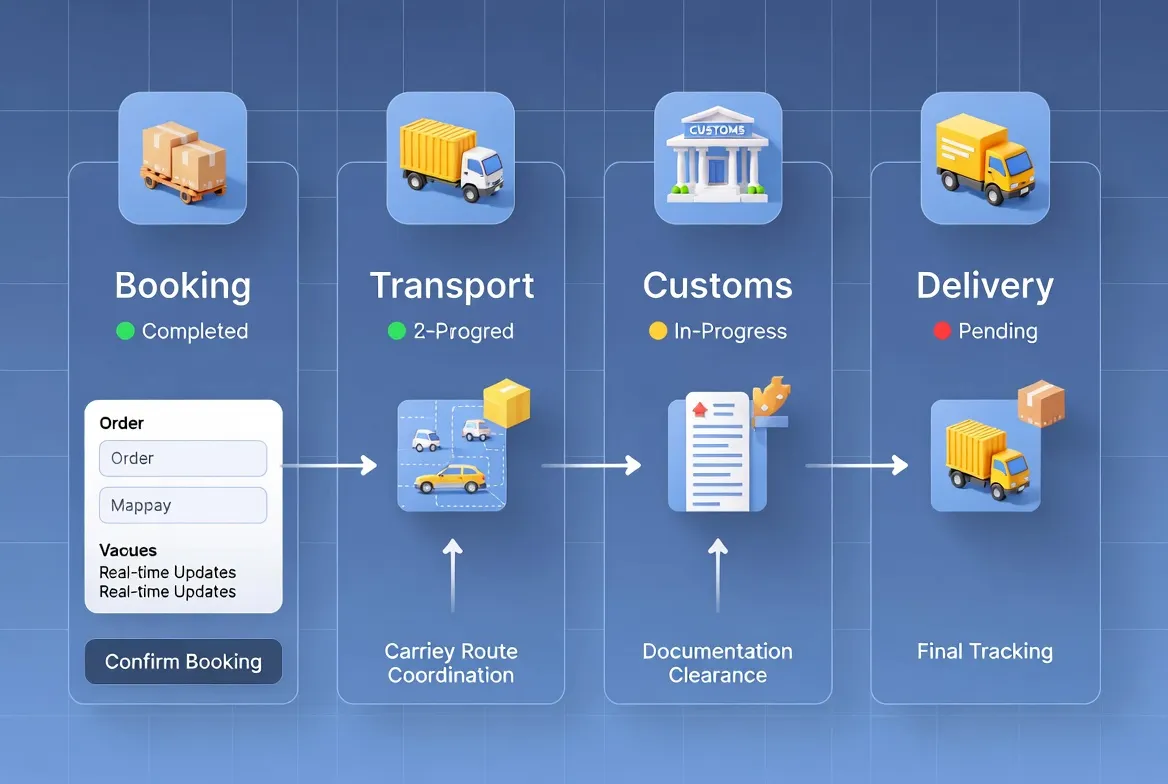
The Explanation: End-to-end milestone visibility refers to the ability to track and monitor every significant event or stage in a shipment's journey, from booking to final delivery. This includes key milestones like cargo pickup, customs clearance, vessel departure/arrival, transhipment points, and final delivery confirmation.
The Solution: A modern LMS aggregates data from various sources – carriers, ports, customs – and presents it in a unified, digestible format. This allows freight forwarders and supply chain teams to view real-time updates and anticipate potential disruptions. For example, if a vessel is delayed, the system immediately flags this, enabling operations teams to adjust downstream plans, inform stakeholders, and mitigate potential impacts. This proactive approach significantly reduces manual inquiry and increases transparency for all parties involved.
2. Multi-Party Collaborative Management: Breaking Down Silos
The Problem: Logistics is inherently a collaborative undertaking, yet traditional methods often involve sequential, siloed communication. Information is passed from one party to the next in a linear fashion, leading to delays, misinterpretations, and a lack of shared context. Coordinating multiple stakeholders – shippers, carriers, customs brokers, warehouses – becomes a constant challenge.
The Explanation: Multi-party collaborative management capabilities within an LMS provide a shared digital workspace where all relevant stakeholders can access, update, and contribute to shipment-related information in real-time. This moves beyond email and phone calls to a structured, auditable environment.
The Solution: An LMS facilitates simultaneous collaboration, allowing all authorized parties to view the same, up-to-date information. For instance, a customs agent can upload necessary documentation directly into the system, which then becomes immediately accessible to the freight forwarder and the consignee. This eliminates the need for endless email chains and ensures everyone is working from the latest information, fostering genuine supply chain synergy. This capability is crucial for enhancing freight forwarding operations, where swift and accurate information exchange is paramount.
3. Process Standardization: Ensuring Consistency and Reducing Errors
The Problem: In the absence of a defined framework, logistics processes can vary significantly between shipments, teams, or even individual operators. This inconsistency breeds inefficiencies, increases the likelihood of errors, and makes it difficult to scale operations or measure performance accurately. Manual data entry for repetitive tasks is a prime example of non-standardized workflows leading to inconsistencies.
The Explanation: Process standardization involves defining and implementing consistent, repeatable workflows for all key logistics activities within the system. This ensures that tasks are performed uniformly, regardless of who is executing them or the specifics of the shipment.
The Solution: An LMS embeds best practices and predefined workflows, guiding users through each step of a logistics process. For example, a template for booking a sea freight shipment might require specific information fields to be completed, ensuring that all necessary data is captured consistently. This not only reduces errors but also accelerates training for new personnel and provides a solid foundation for continuous improvement. By standardizing procedures, the system contributes directly to logistics digitalization, turning ad-hoc activities into structured, efficient operations.
4. Automation of Manual Coordination: Freeing Up Resources
The Problem: Many aspects of traditional logistics involve repetitive, manual coordination tasks – sending status updates, requesting documents, chasing approvals. These tasks are time-consuming, prone to human error, and detract from more strategic work that requires human intelligence.
The Explanation: Automation of manual coordination leverages the LMS to automatically trigger actions, notifications, and information exchanges based on predefined rules or milestone achievements. This moves beyond simple alerts to intelligent task delegation and communication.
The Solution: A sophisticated LMS can automate numerous manual touchpoints. For example, once a vessel departs, the system can automatically send a notification to the consignee with the updated estimated time of arrival (ETA) and a link to track the shipment. Similarly, it can automatically prompt customs agents for documentation submission as a shipment approaches a port. This automation significantly reduces the administrative burden on operations teams, allowing them to focus on exception handling, problem-solving, and building stronger customer relationships. It's a fundamental shift towards more efficient freight forwarding operations.
5. Real-time Operational Transparency: Gaining True Insight
The Problem: Without real-time operational transparency, decision-making in logistics is often based on outdated or incomplete information. This reactive posture makes it difficult to anticipate issues, optimize resource allocation, or provide accurate, timely responses to customer inquiries. The true cost and efficiency of a supply chain are often obscured.
The Explanation: Real-time operational transparency means that all relevant data and statuses within the logistics process are continuously updated and immediately accessible to authorized users. It provides a living, breathing overview of all active operations.
The Solution: An LMS provides dashboards and reporting tools that offer a panoramic view of ongoing operations. For instance, a logistics manager can instantly see the status of all active shipments, identify potential delays, and monitor key performance indicators (KPIs) in real-time. This allows for data-driven decisions, such as re-routing shipments to avoid congested areas or allocating additional resources to manage peak demand. This level of insight is crucial for fostering advanced supply chain collaboration and enhancing overall performance measurement.
6. Scalable Cloud Architecture: Adaptability and Accessibility
The Problem: Legacy logistics systems are often on-premise, inflexible, and expensive to maintain and upgrade. They struggle to adapt to fluctuating business demands, geographic expansion, or the integration of new technologies, posing significant barriers to logistics digitalization.
The Explanation: A scalable cloud architecture means the LMS is hosted on cloud infrastructure, allowing it to easily expand or contract resources based on demand. This provides flexibility, global accessibility, and reduces the need for heavy upfront IT investment.
The Solution: A cloud-based LMS offers unparalleled flexibility and accessibility. Companies can scale their operations up or down without significant hardware investments. It enables global teams to access the system from anywhere, at any time, promoting seamless collaboration across different regions. Furthermore, cloud platforms inherently offer higher levels of security, reliability, and automatic updates, ensuring the system remains current and resilient against disruptions. This architectural choice is foundational for truly global freight forwarding operations and future-proof logistics digitalization.

Modern Collaborative Logistics Systems: Driving Efficiency
In essence, a modern, collaborative logistics management system transcends the traditional definition of mere tracking software. By integrating end-to-end visibility, multi-party collaboration, process standardization, and automation within a scalable cloud framework, these systems fundamentally reshape how goods move globally. They replace manual, reactive processes with proactive, data-driven workflows, creating an environment of continuous operational efficiency. The collective impact is a more resilient, responsive, and transparent supply chain, capable of navigating the complexities of global trade with unprecedented agility and control.