.webp "How Modern Platforms Enable Cargo Movement Monitoring")
Mar 12,2026
How Modern Platforms Enable Cargo Movement Monitoring
In today’s fast-paced eCommerce environment, delivering exceptional customer experiences isn’t just a competitive advantage—it’s a necessity. To meet growing demands for speed, accuracy, and transparency, modern retailers need more than manual processes. They need integrated order fulfillment software that connects the eCommerce platforms, warehouses, carriers, and financial systems into a seamless, automated workflow.
What is Order Fulfillment Software?
Order fulfillment software is a powerful, centralized platform that handles everything from receiving eCommerce orders to packaging, shipping, and returns. It unifies critical processes, such as inventory control, order synchronization, and carrier selection in one coherent system, eliminating the friction of disconnected tools.
The integration avoids data silos and human errors, and offers real-time visibility across sales channels, warehouse operations, and logistics partners. Retailers can finally orchestrate their fulfillment workflows reliably and at scale, including cross-border complexities.
Key Features of Order Fulfillment Software
Real-time Order Synchronization: Connects automatically with Shopify, Amazon, eBay, etc., eliminating manual data entry.
Multi-warehouse Inventory Visibility: Tracks stock across locations, preventing overselling.
Automated Picking, Packing & Labeling: Generates shipment documents instantly and integrates with automated hardware like scanners and printers.
Carrier Rate Shopping & Smart Routing: Matches the most efficient carrier and route for each order.
Returns & Reverse Logistics Module: Simplifies returns with automated labels and restocking.
Comprehensive BI & Reporting: Shows key metrics such as fulfillment speed, costs, and inventory health.
Benefits of Using Order Fulfillment Software
Faster Processing Times: Automation accelerates order completion and dispatch.
Greater Accuracy: Barcode scanning and workflow logic reduce dispatch errors.
Lower Operational Costs: Labor savings and better routing deliver cost efficiency.
Seamless Scaling: High volume spikes, such as holidays, are managed without system strain.
Elevated Customer Experience: Faster deliveries, tracking transparency, and self-service boost satisfaction.
Integrating Order Fulfillment Software with eCommerce Platforms
To unlock full potential, fulfillment software must integrate deeply and intelligently with eCommerce platforms and logistics partners.
Common Requirements for eCommerce Fulfillment Software
API & EDI Connectivity: Enables real-time data exchange between systems.
Multi-channel Order Aggregation: Combines orders from various platforms into one dashboard.
Instant Inventory Sync: Ensures stock accuracy after each transaction.
Workflow Automation Rules: Prioritizes orders by region, weight, or customer level.
Cross-border Logistics Automation: Manages customs documents, duties, taxes, and compliance.
Why an Integrated Logistics System Matters?
An integrated approach brings every stakeholder and workflow (sales channels, warehouses, carriers, finance, and customer service) onto a single logistics management system backbone, eliminating the data silos and handoffs that slow fulfillment and create errors.
When orders, inventory, shipping, billing, and analytics run through one connected platform, teams gain real-time visibility to act faster, automate routine tasks, and scale reliably during peak demand without sacrificing accuracy.
This end-to-end continuity also sharpens decision-making. Leaders see true costs and service levels across first, middle, and last mile, spot bottlenecks early, and optimize inventory placement, carrier mix, and SLA performance. For growing brands and 3PLs alike, integration is not just an IT preference—it’s the operational advantage that turns speed, transparency, and consistency into a durable customer experience.
WallTech Solutions of Order Fulfillment Software
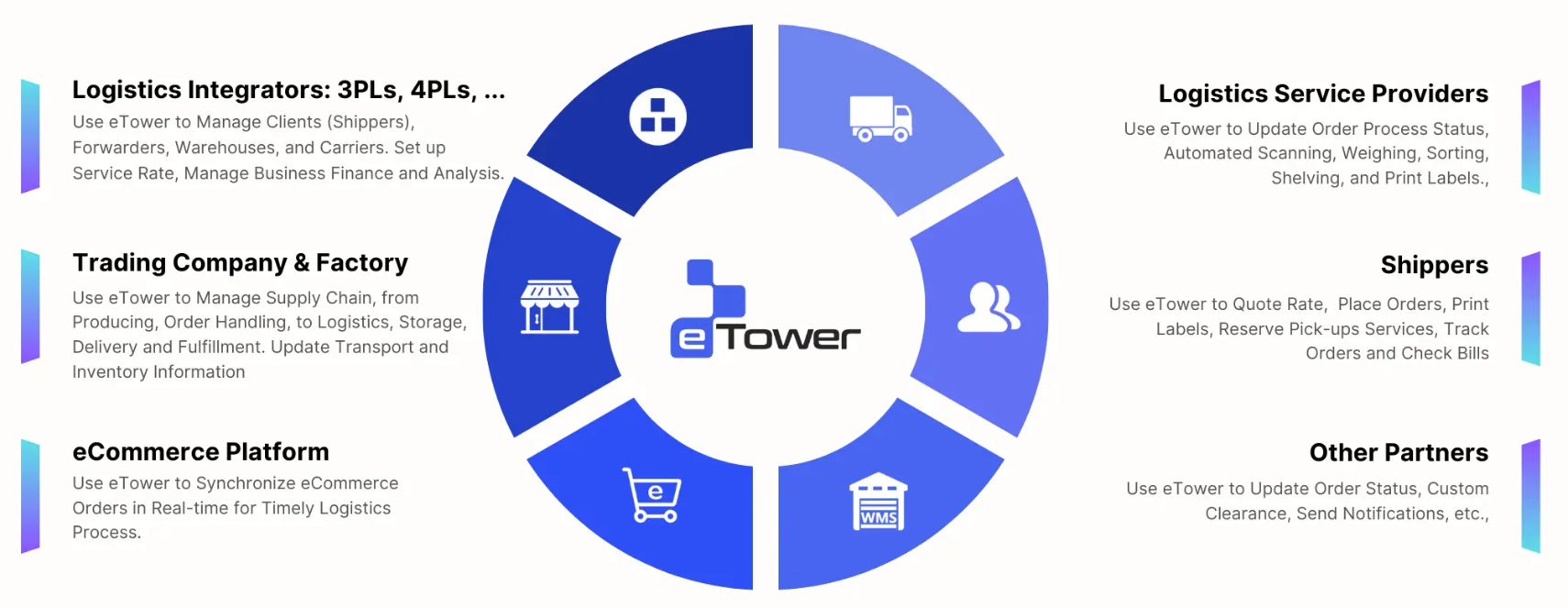
The logistics management platforms from WallTech company—eTowerB2C and eTowerOne—enable modern integration at scale:
eTowerB2C: Built for high-volume direct-to-consumer shipping. It supports real-time tracking, intelligent routing, one-click carrier quote and ordering, and label generation with millisecond latency. It integrates with major carriers and eCommerce channels—including Amazon, Shopify, and global courier networks—ensuring smooth end-to-end parcel management.
eTowerOne: A modular, AWS-hosted enterprise SaaS that supports multi-warehouse inventory, B2B and 3PL workflows, customizable billing, and end-to-end logistics orchestration. It simplifies managing fulfillment centers, consolidations, and client-specific rules.
A standout 2024 upgrade in eTowerOne is the new Fulfillment Order Quotation function, designed to empower both shippers and logistics providers to estimate fulfillment costs before initiating an order. Users can search based on shipping options, warehouse location, recipient data, package specs, and SKU-level details. This powerful pre-order pricing visibility aids in cost planning and service matching.
Integrated order fulfillment software is vital for eCommerce businesses looking to scale with precision and efficiency. With integrated logistics management tools like WallTech’s eTowerB2C and eTowerOne, brands and logistics providers gain real-time visibility, automation, and pricing intelligence, from order to delivery.
FAQs of Order Fulfillment Software
What is eCommerce fulfillment?
eCommerce fulfillment encompasses everything from order placement to delivery and returns. It includes receiving inventory, processing orders, packaging items, shipping them, and handling returns—all executed through a digital logistics infrastructure.
How does fulfillment software improve efficiency?
It streamlines workflows—from order capture through warehouse processing and shipping—automating tasks like label generation, inventory updates, and carrier selection. This reduces labor, accelerates delivery, and minimizes errors.
What are the advantages of using eCommerce fulfillment software for small businesses?
Small businesses benefit from cost savings, faster fulfillment, and automated processes that would otherwise require significant manual effort. Scalable SaaS platforms grow with the business, avoiding future migration costs.
Can order fulfillment software reduce operational costs?
Yes. By automating manual tasks, optimizing carrier selections, and reducing errors, fulfillment systems lower both labor and shipping costs.
Is fulfillment software useful for 3PL (Third-Party Logistics) providers?
Absolutely. 3PL fulfillment software helps manage multiple clients, offers multi-currency billing, handles inventory for different sellers, and provides separate dashboards, simplifying operations at scale.