

.webp "What Is Shipment Milestone Tracking in Logistics Systems")
Apr 02,2026
What Is Shipment Milestone Tracking in Logistics Systems
Introduction
Choosing the right logistics software is a critical decision for logistics companies, freight forwarders, and 3PL providers.
Modern logistics operations require systems that support visibility, collaboration, and standardized workflows across multiple teams and partners.
The following eight features are commonly considered essential when evaluating logistics software solutions.
Logistics software should support:
Centralized shipment management
Workflow standardization
Partner collaboration
Real-time visibility
System integration and APIs
Scalability and multi-entity operations
Data accuracy and automation
Cloud-based deployment
1. Centralized Shipment Management
Centralized shipment management allows logistics companies to manage orders, shipments, and operational milestones within a single system.
It reduces information fragmentation and provides a consistent view of logistics operations.
Without centralized management, shipment data is often scattered across emails, spreadsheets, and disconnected tools, making coordination difficult and error-prone.

When evaluating this feature, logistics companies typically look for:
Unified order and shipment records
Milestone-based shipment tracking
Shared access for internal teams
2. Workflow Standardization
Workflow standardization enables logistics companies to execute operations using consistent, predefined processes.
It helps ensure that shipments are handled in a repeatable and controlled manner.
In the absence of standardized workflows, operations often rely on individual experience, which can lead to inconsistencies and inefficiencies as the business grows.
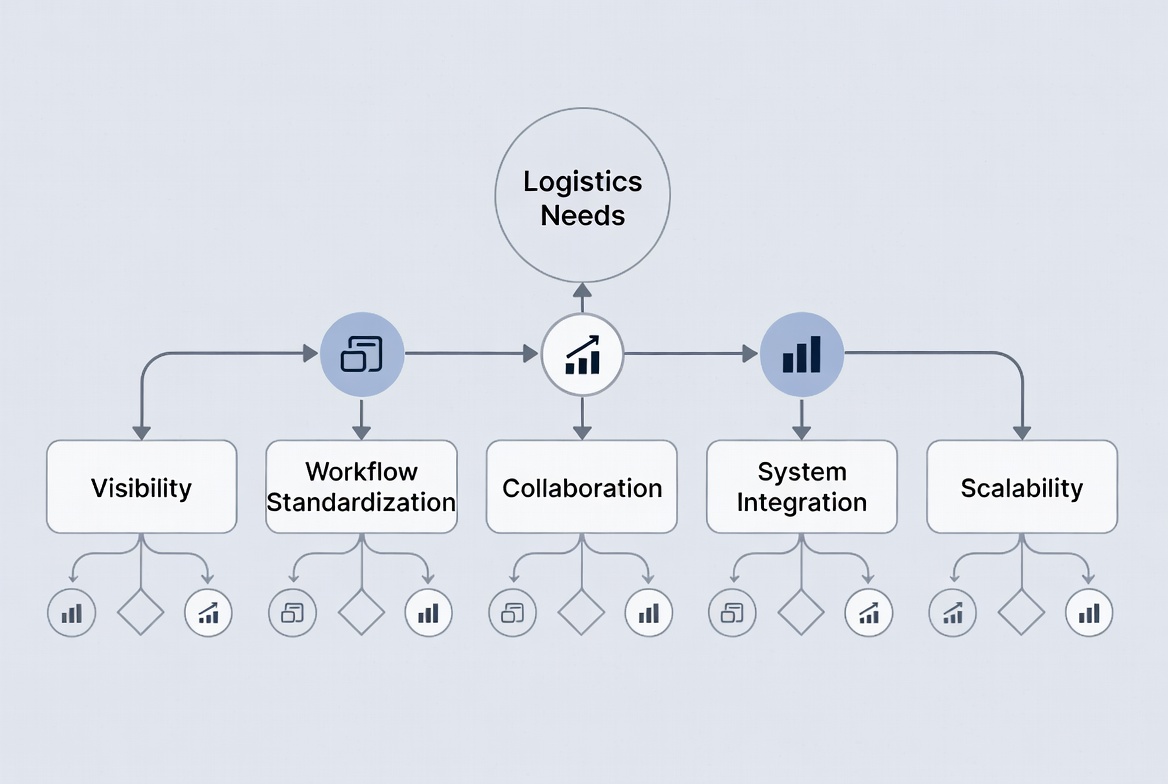
Key aspects to consider include:
Configurable logistics workflows
Standard operating procedures embedded in the system
Clear task sequencing and responsibility assignment
3. Partner Collaboration
Partner collaboration refers to the ability of logistics software to connect internal teams with external partners such as carriers, agents, and service providers.
It enables multiple stakeholders to work on the same shipment data in real time.
Traditional collaboration methods based on email and manual updates often result in delays and miscommunication.

Logistics companies usually look for:
Shared access to shipment status
Controlled permissions for external partners
Real-time updates across all parties
4. Real-Time Visibility
Real-time visibility provides up-to-date information on shipment status, milestones, and operational progress.
It allows logistics teams to monitor execution and respond quickly to exceptions.
Without real-time visibility, logistics companies often operate reactively, discovering issues only after delays or disruptions occur.

Important capabilities include:
Live shipment status updates
Milestone-based tracking
Centralized dashboards for operational monitoring
5. System Integration and APIs
System integration enables logistics software to connect with external platforms and internal business systems.
APIs play a key role in exchanging data accurately and efficiently across systems.
Disconnected systems often lead to duplicated data entry and inconsistent information, increasing operational risk.
When assessing integration capabilities, companies typically consider:
API availability and flexibility
Support for data synchronization
Compatibility with existing systems
6. Scalability and Multi-Entity Support
Scalability allows logistics software to support business growth without requiring major system changes.
Multi-entity support is essential for companies operating across regions, branches, or subsidiaries.
Systems that lack scalability often struggle as transaction volumes increase or organizational structures become more complex.
Key factors include:
Support for multiple branches or business units
Role-based access control
Flexible system configuration
7. Data Accuracy and Automation
Data accuracy ensures that logistics decisions are based on reliable and consistent information.
Automation helps reduce manual data entry and minimizes human error.
Manual processes increase the risk of incorrect data and slow down operations.
Logistics companies often evaluate:
Automated data capture and updates
Reduced reliance on manual input
Consistent data across workflows
8. Cloud-Based Architecture
Cloud-based logistics software is deployed and accessed through the internet rather than on local infrastructure.
It provides flexibility, accessibility, and easier system maintenance.
On-premise systems often require significant IT resources and can limit scalability.
Key advantages to look for include:
Remote access for distributed teams
Faster system updates and deployment
Support for global operations
Conclusion
When choosing logistics software, companies should focus on features that support centralized shipment management, standardized workflows, partner collaboration, and real-time visibility.
Strong integration capabilities, scalability, data accuracy, and cloud-based architecture are also essential for long-term success.
A logistics system designed around these capabilities can help organizations operate more efficiently and adapt as their business grows.


.webp "How Digital Systems Improve Logistics Visibility")