
.webp "Best Practices for Managing Agent Collaboration")
Mar 13,2026
Best Practices for Managing Agent Collaboration
Introduction
Logistics rate management refers to the process of organizing, maintaining, and applying freight pricing data across transportation services, routes, carriers, and partners. It matters because accurate and structured rate management directly impacts cost control, pricing consistency, and profitability for logistics companies. In an industry where margins are tight and pricing is complex, effective rate management ensures operational efficiency and financial accuracy.
What is Logistics Rate Management
Logistics rate management is the systematic handling of all pricing-related data used in freight operations. This includes:
Ocean, air, and land freight rates
Carrier contracts and tariffs
Surcharges (fuel, peak season, congestion, etc.)
Customer-specific pricing agreements
Multi-leg and multimodal pricing structures
Traditionally, many freight forwarders manage rates in spreadsheets or disconnected systems, which leads to fragmented data and frequent errors.
Modern logistics platforms centralize all rate information into structured databases, allowing teams to access, update, and apply pricing rules consistently across operations.
Why Logistics Rate Management Matters
Rate management plays a critical role in both operational execution and financial performance.
1. Pricing Accuracy
Incorrect rates can lead to undercharging or overquoting, directly impacting profitability and customer trust.
2. Speed of Quotation
Manual rate lookup slows down quotation processes, especially when dealing with complex routes or multiple carriers.
3. Margin Control
Without clear cost and selling price structures, it becomes difficult to monitor profit at the shipment level.
4. Global Coordination
For companies operating across regions, inconsistent rate data can create confusion between teams and partners.
5. Customer Experience
Delayed or inconsistent pricing reduces competitiveness in fast-paced logistics markets.
How Logistics Rate Management Works
A modern logistics rate management process typically follows these steps:
1. Rate Input and Structuring
Rates are imported from carriers, contracts, or spreadsheets into the system. Structured formats define:
Origin and destination
Transport mode
Validity periods
Pricing units (per container, per kg, etc.)
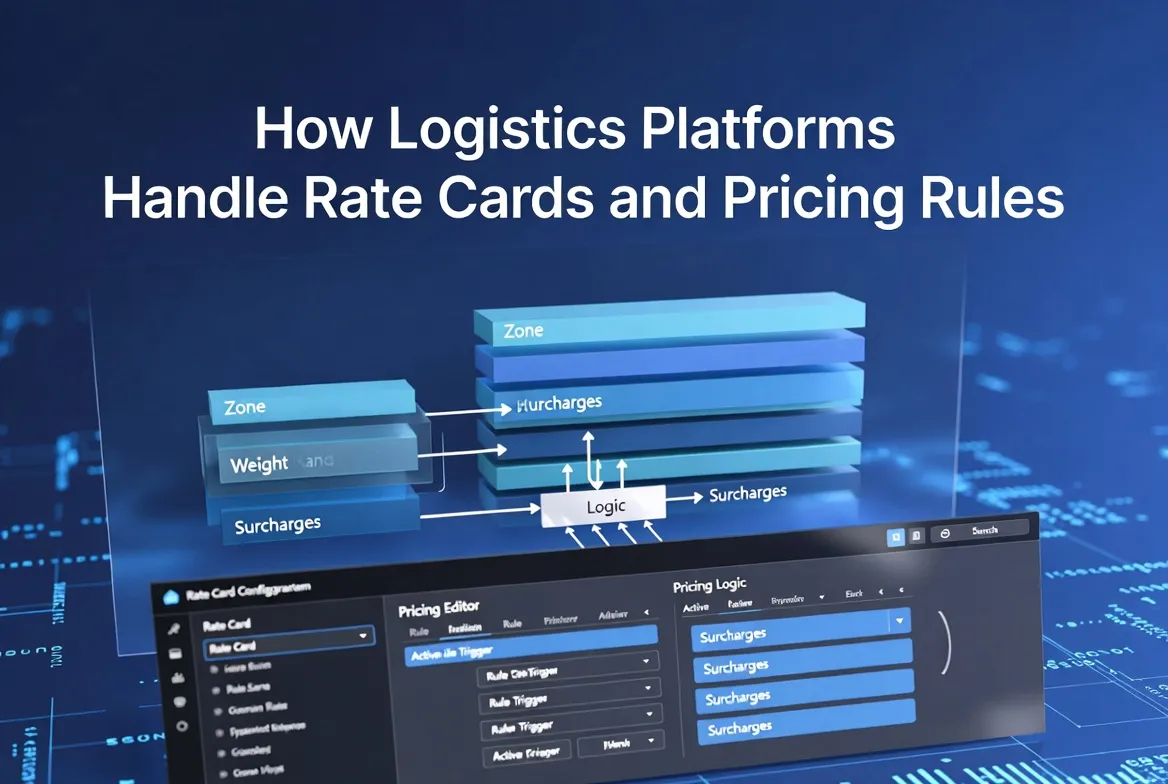
2. Rule Configuration
Pricing rules are applied, such as:
Surcharge combinations
Minimum charges
Customer-specific discounts
Route-based conditions
3. Rate Matching and Application
When a shipment or quotation is created, the system automatically matches the relevant rates based on shipment details.
4. Real-Time Updates
Rate changes are updated centrally, ensuring all teams use the latest pricing data.
5. Integration with Operations and Finance
Rates are directly linked to order creation, billing, and profit calculation, ensuring consistency across workflows.
Key Features / Key Capabilities
Modern logistics platforms provide advanced capabilities for rate management:
Centralized Rate Database
Store and manage all carrier and customer rates in one systemMulti-Condition Pricing Logic
Support complex pricing scenarios across routes, weights, and servicesAutomated Rate Matching
Instantly apply correct rates during quotation and order creationVersion Control and Validity Management
Track rate changes over time with effective date rangesMulti-Currency Support
Handle global operations with automatic currency conversionCollaboration Across Teams
Enable pricing, sales, and operations teams to work on unified dataIntegration with Shipment Workflows
Ensure rates are directly tied to execution and financial processes
Benefits for Logistics Companies
Implementing structured rate management delivers measurable benefits:
Improved Quotation Efficiency
Faster response to customer inquiries with automated pricingReduced Manual Errors
Eliminate inconsistencies caused by spreadsheet-based processesBetter Profit Visibility
Track margins at shipment, customer, or route levelEnhanced Collaboration
Align pricing teams with operations and finance through shared dataScalability
Handle increasing shipment volumes without increasing manual workloadStronger Competitive Positioning
Provide accurate and timely pricing in competitive markets
Best Practices / Use Cases
To maximize the effectiveness of logistics rate management:
1. Standardize Rate Structures
Use consistent formats for all pricing data to avoid confusion.
2. Centralize Data Management
Avoid storing rates in multiple disconnected files or systems.
3. Automate Rate Updates
Use system workflows to update and validate rates regularly.
4. Link Rates to Operational Workflows
Ensure pricing is directly connected to shipment creation and billing.
5. Enable Cross-Team Collaboration
Allow sales, pricing, and operations to access the same rate data.
Use Case Example:
A global freight forwarder managing multiple regional offices can use a centralized rate system to ensure all branches apply consistent pricing while still allowing local adjustments. This improves coordination and reduces pricing conflicts across markets.
Conclusion
Logistics rate management is a foundational capability for modern logistics operations. By structuring and automating pricing processes, companies can improve accuracy, speed, and profitability. As logistics networks become more complex, centralized and intelligent rate management systems are essential for maintaining control and competitiveness.
Frequently Asked Questions
What is logistics rate management?
It is the process of organizing and applying freight pricing data across carriers, routes, and services to ensure accurate and consistent pricing.
How does logistics rate management work?
It involves structuring rate data, applying pricing rules, and automatically matching rates to shipments or quotations within a system.
Why is rate management important in logistics?
It ensures pricing accuracy, improves operational efficiency, and helps control costs and profitability.
What are the benefits of automated rate management?
Automation reduces errors, speeds up quotation processes, and provides better visibility into margins and costs.
About WallTech
WallTech provides digital solutions designed to support end-to-end logistics operations for freight forwarders and supply chain companies. Its platforms enable multi-role collaboration across teams and partners, ensuring seamless coordination throughout the shipment lifecycle. With real-time visibility, milestone-based tracking, and unified timelines, logistics companies can maintain full operational control. WallTech also supports workflow automation, including rate management, billing, and financial reconciliation, helping businesses reduce manual work and improve efficiency. These capabilities allow logistics companies to scale operations while maintaining accuracy and consistency.
If you're exploring ways to improve your logistics operations, feel free to connect with us to learn more about our solutions and system capabilities.
.webp "What Is an Ocean Freight Management System?")
.webp "What Is a Freight Operations System?")