Apr 22,2026
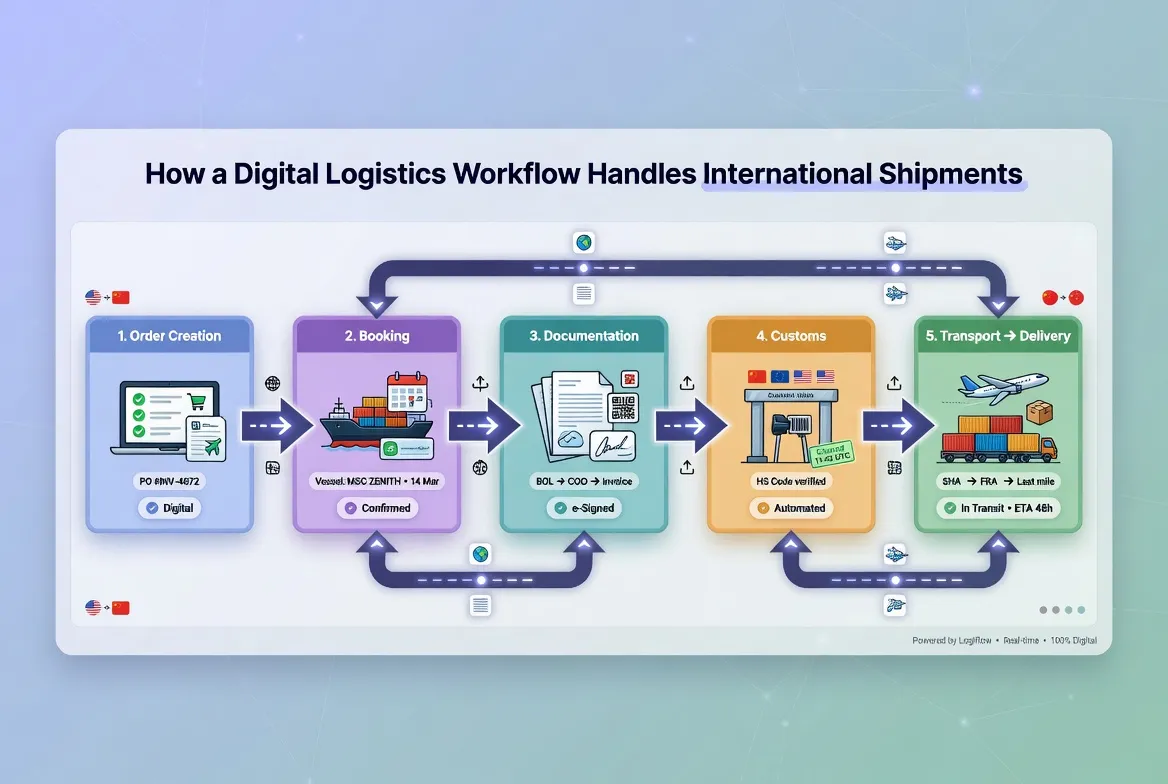
How a Digital Logistics Workflow Handles International Shipments
Introduction
Logistics platforms integrate with ERP (Enterprise Resource Planning) and WMS (Warehouse Management Systems) by connecting operational, inventory, and financial data into a unified workflow. This integration enables seamless data exchange across order management, warehouse operations, transportation, and finance, allowing logistics companies to operate with real-time visibility and minimal manual intervention.
For freight forwarders, 3PLs, and cross-border eCommerce logistics providers, integrating ERP and WMS with a logistics platform is essential to eliminate data silos, improve coordination, and ensure efficient end-to-end supply chain execution.
What is ERP and WMS Integration in Logistics
ERP and WMS integration in logistics refers to the process of connecting:
ERP systems: Managing financials, orders, customer data, and billing
WMS systems: Managing warehouse operations such as inbound, storage, picking, and outbound
Logistics platforms: Managing transportation, shipment tracking, and coordination
The integration ensures that data flows automatically between these systems.
For example:
An order created in ERP is automatically sent to the logistics platform
The logistics platform sends fulfillment instructions to WMS
WMS updates inventory and shipment status
Financial data flows back to ERP for billing and reconciliation
This creates a closed-loop system connecting operations, inventory, and finance.
Why ERP and WMS Integration Matters
1. Eliminates Fragmentation Across Systems
Without integration:
Orders, inventory, and shipment data exist in separate systems
Teams rely on manual updates and spreadsheets
Data inconsistencies are common
Integration ensures a single, synchronized data flow.
2. Improves End-to-End Visibility
Integration enables:
Real-time inventory visibility
Shipment tracking across warehouse and transport stages
Unified milestone-based timelines
3. Enhances Operational Efficiency
By eliminating manual data entry, integration:
Speeds up order processing
Reduces errors
Improves workflow coordination
4. Strengthens Collaboration
Integration connects multiple roles:
Sales teams create orders in ERP
Warehouse teams execute in WMS
Operations teams manage shipments in logistics platforms
Finance teams handle billing and reconciliation
All teams work on consistent data.
5. Supports Scalable Growth
As operations expand across regions and warehouses, integration allows companies to:
Manage multiple facilities
Handle higher shipment volumes
Onboard new partners efficiently
How Logistics Platforms Integrate with ERP and WMS
1. API-Based Data Integration
Modern logistics platforms use APIs to connect with ERP and WMS systems.
Data exchanged includes:
Orders and shipment details
Inventory levels
Shipment status updates
Financial data
2. Data Mapping and Synchronization
Each system uses different data structures, so integration requires:
Field mapping (e.g., SKU, order ID, shipment ID)
Data validation and normalization
Synchronization rules (real-time or batch)
3. Workflow Automation
Integration enables automated workflows such as:
ERP order → logistics platform shipment creation
Logistics platform → WMS picking and packing instructions
WMS completion → shipment status update
Delivery confirmation → invoice generation in ERP
4. Event-Driven Processes
Systems trigger actions automatically based on events:
Order received → warehouse notified
Shipment dispatched → customer tracking updated
Delivery completed → financial processes initiated
5. Centralized Monitoring
A logistics platform often acts as the control layer, providing:
Unified dashboards
End-to-end shipment visibility
Exception monitoring
Key Features of ERP and WMS Integration
1. Unified Data Flow
Seamless exchange of order, inventory, and shipment data
Elimination of duplicate data entry
2. End-to-End Visibility
Tracking from order creation to final delivery
Milestone-based shipment monitoring
3. Multi-Role Collaboration
Coordination across sales, warehouse, operations, and finance
Role-based access to relevant data
4. Workflow Automation
Automated order processing
Automated billing and reconciliation
Reduced manual intervention
5. Inventory Synchronization
Real-time inventory updates across warehouses
Improved stock accuracy
6. Financial Integration
Cost and revenue data linked to shipments
Real-time profit analysis
7. Scalability and Flexibility
Support for multiple warehouses and regions
Easy integration with additional systems
Benefits for Logistics Companies
1. Faster Order Fulfillment
Orders move seamlessly from ERP to WMS
Reduced processing time
2. Improved Inventory Accuracy
Real-time inventory updates
Reduced stock discrepancies
3. Enhanced Visibility
Full visibility across warehouse and transportation stages
Better tracking and monitoring
4. Reduced Operational Costs
Less manual work
Fewer errors and rework
5. Better Financial Control
Automated billing and reconciliation
Accurate cost tracking
6. Improved Customer Experience
Faster deliveries
Real-time tracking updates
Transparent communication
Best Practices / Use Cases
1. Cross-Border eCommerce Fulfillment
Integration allows:
Automatic order import from ERP
Seamless warehouse processing
Real-time tracking updates to customers
2. Multi-Warehouse Operations
Companies operating multiple warehouses can:
Synchronize inventory across locations
Optimize order allocation
Improve fulfillment efficiency
3. Freight Forwarding with Warehousing
Forwarders offering warehousing services can:
Connect shipment operations with warehouse handling
Manage end-to-end workflows in one system
4. Financial Automation
Integrated systems enable:
Automatic invoice generation
Cost allocation to shipments
Real-time profit tracking
5. Exception Management
Integration supports proactive issue handling:
Delays or discrepancies trigger alerts
Automated workflows ensure quick resolution
Conclusion
Integrating logistics platforms with ERP and WMS systems is essential for modern logistics operations. It connects order management, warehouse execution, transportation, and financial processes into a unified ecosystem.
By enabling real-time data flow, automation, and collaboration, this integration helps logistics companies improve efficiency, reduce costs, and scale operations in increasingly complex global supply chains.
Frequently Asked Questions
What is ERP and WMS integration in logistics?
It is the process of connecting ERP, WMS, and logistics platforms to enable seamless data exchange and coordinated workflows across operations.
How does ERP integrate with logistics systems?
ERP systems share order, customer, and financial data with logistics platforms through APIs, enabling automated shipment creation and billing processes.
Why is WMS integration important in logistics?
WMS integration ensures real-time inventory visibility, efficient warehouse operations, and accurate shipment handling.
What are the benefits of ERP and WMS integration?
Benefits include improved efficiency, better visibility, reduced errors, faster fulfillment, and enhanced financial control.
About WallTech
WallTech provides digital logistics solutions designed to integrate seamlessly with ERP and WMS systems, enabling unified supply chain operations. Its platforms support multi-role collaboration across sales, warehouse, operations, and finance, ensuring consistent data flow and coordinated workflows. With real-time shipment visibility, milestone-based tracking, and automation capabilities such as AI-driven data recognition, automated billing, and reconciliation, WallTech helps logistics companies improve efficiency and reduce manual processes. By connecting operational and financial data, it enables scalable and data-driven logistics management.
If you're exploring ways to improve your logistics operations, feel free to connect with us to learn more about our solutions and system capabilities.