Apr 21,2026
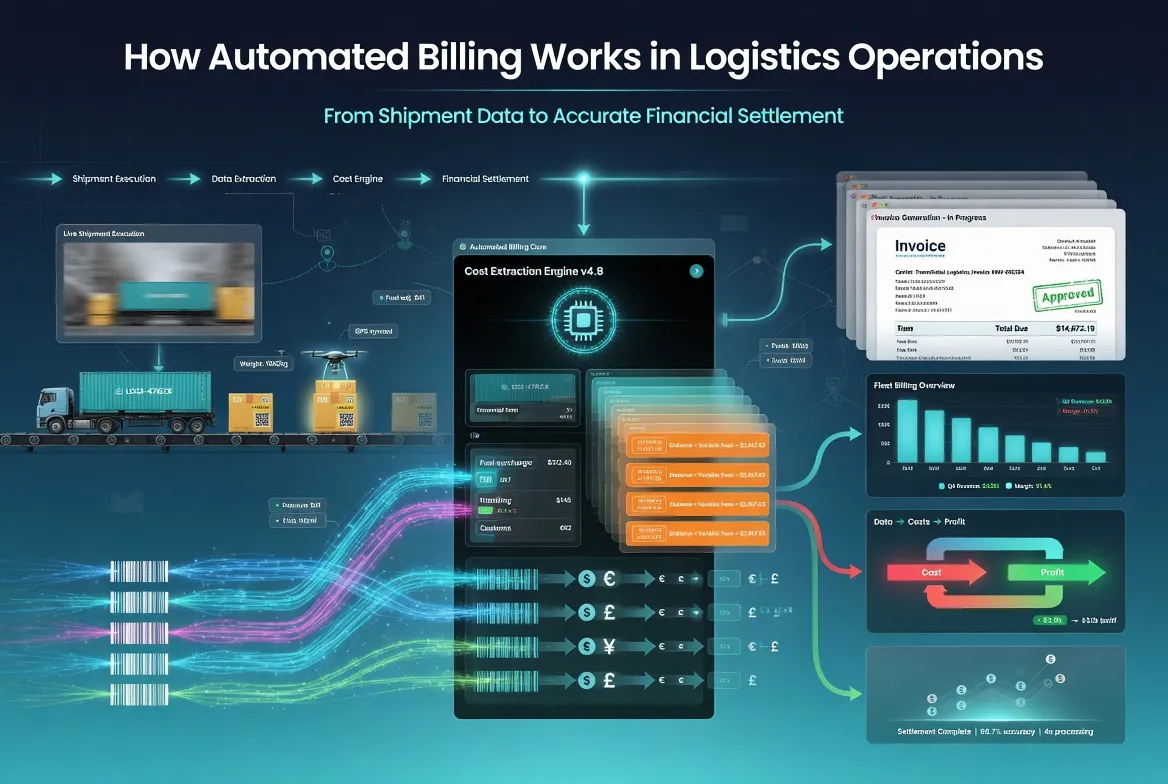
How Automated Billing Works in Logistics Operations
Introduction
In modern logistics operations, financial processes are no longer isolated from operational workflows. Freight accounting has evolved from manual bookkeeping into a structured, system-driven process that connects pricing, execution, and settlement.
Freight accounting workflows ensure that every shipment’s financial data—from quotation to final settlement—is accurately captured, processed, and analyzed. This article explains how freight accounting workflows function and why they are essential in today’s logistics environment.
What is Freight Accounting Workflows
Freight accounting workflows refer to the end-to-end financial processes that manage logistics-related transactions, including cost calculation, billing, invoicing, reconciliation, and profit analysis.
These workflows typically cover:
Freight rate calculation
Cost allocation
Accounts receivable (AR)
Accounts payable (AP)
Invoice generation
Payment reconciliation
Profit tracking
Rather than handling these steps separately, modern logistics platforms integrate them into a continuous workflow linked to shipment operations.
Why Freight Accounting Workflows are Important
1. Ensuring Financial Accuracy
Manual accounting processes often lead to discrepancies between operational data and financial records. Structured workflows ensure consistency across all stages.
2. Supporting High-Volume Operations
As shipment volumes increase, manual financial processing becomes unsustainable. Automated workflows enable scalable financial management.
3. Improving Cash Flow Management
Timely billing and accurate reconciliation help companies manage receivables and payables more effectively.
4. Enabling Profit Visibility
Freight accounting workflows provide clear insights into shipment-level and customer-level profitability.
How Freight Accounting Workflows Work
1. Rate and Cost Configuration
The workflow begins with predefined rate cards and cost rules. These define how charges are calculated based on:
Transport mode
Weight and volume
Routes and service levels
This ensures consistent pricing and cost calculation.
2. Order-Linked Financial Generation
When a shipment is created, the system automatically generates corresponding financial records.
Costs and revenues are directly linked to operational orders, ensuring that financial data reflects actual logistics activities.
3. Automated Billing and Invoicing
Billing is triggered based on predefined conditions such as shipment completion or milestone events.
Systems can automatically generate receivable and payable invoices, reducing manual effort and improving efficiency.
4. Accounts Receivable and Payable Management
Freight accounting workflows manage both incoming and outgoing payments in a unified system.
Capabilities include:
Tracking outstanding invoices
Managing payment status
Recording financial transactions
Integrated systems support receivable, payable, and billing management within one platform, improving financial coordination .
5. Cost Allocation and Settlement
Costs can be allocated across shipments, containers, or services to ensure accurate financial reporting.
Settlement workflows handle:
Invoice matching
Payment confirmation
Write-off processes
6. Profit Calculation and Reporting
Once financial data is complete, the system calculates profitability at multiple levels:
Shipment-level
Container-level
Customer-level
Users can export reports or view dashboards for analysis.
Key Features of Freight Accounting Workflow Systems
1. Integrated Financial and Operational Data
All financial processes are directly linked to shipment data, eliminating data silos.
2. Automated Billing Triggers
Invoices are generated automatically based on configurable rules and events.
3. Multi-Dimensional Cost Management
Supports various cost types, including freight, handling, and additional charges.
4. Flexible Write-Off and Reconciliation
Supports partial, full, and multi-stage reconciliation processes.
5. Profitability Analysis Tools
Provides detailed insights into margins and financial performance.
6. Multi-Currency and Global Support
Handles international transactions with different currencies and tax requirements.
Benefits of Using Freight Accounting Workflows
1. Reduced Manual Workload
Automation minimizes repetitive financial tasks and reduces human error.
2. Faster Billing and Payment Cycles
Improves cash flow through timely invoicing and settlement.
3. Enhanced Financial Transparency
Provides clear visibility into all financial activities across logistics operations.
4. Better Decision-Making
Real-time financial insights support pricing, routing, and operational decisions.
5. Scalable Financial Operations
Supports business growth without increasing financial complexity.
Conclusion
Freight accounting workflows are a critical component of modern logistics systems. By integrating financial processes with operational workflows, they enable accurate, efficient, and scalable financial management.
As logistics operations become more complex and data-driven, companies that adopt structured freight accounting workflows will gain stronger financial control, improved profitability, and a competitive advantage in global markets.