May 21,2026
How Do Freight Systems Monitor Cargo Movement Across Supply Chains?
Introduction
Cross-border logistics platforms for global logistics data integration are digital systems that connect, standardize, and synchronize data across multiple systems, stakeholders, and regions involved in international logistics operations. These platforms enable logistics companies to consolidate fragmented data from ERP systems, carriers, warehouses, customs platforms, and partners into a single, unified data environment.
In global logistics, data is often scattered across disconnected systems, leading to inefficiencies, duplication, and poor decision-making. Cross-border logistics platforms address this by enabling seamless data integration, ensuring consistent, real-time information flow across the entire logistics ecosystem.
What is Cross-Border Logistics Platforms for Global Logistics Data Integration
A cross-border logistics platform for global logistics data integration is a centralized system that aggregates and harmonizes data from various internal and external sources involved in international logistics operations.
It integrates:
Order and shipment data
Tracking and event data
Inventory and warehouse data
Financial and billing data
Partner and carrier data
The goal is to create a single source of truth that supports end-to-end logistics operations and decision-making.
Why Cross-Border Logistics Platforms Matter
Global logistics operations face significant data challenges:
Data silos: Different systems store data independently
Manual data entry: Repeated input across systems leads to errors
Inconsistent formats: Data from different sources lacks standardization
Limited real-time access: Delayed updates hinder decision-making
Integration complexity: Connecting multiple systems is technically challenging
These issues result in inefficiencies, operational delays, and poor visibility.
Cross-border logistics platforms are essential because they:
Enable seamless data exchange across systems
Reduce manual data handling and errors
Provide real-time, consistent information
Improve operational efficiency and coordination
Support data-driven decision-making
How Cross-Border Logistics Platforms Work
These platforms integrate logistics data through structured connectivity and processing.
1. Data Collection from Multiple Systems
The platform gathers data from:
ERP systems (orders and financials)
WMS systems (inventory and warehouse operations)
Carrier systems (tracking and transport data)
Customs systems (compliance and clearance data)
Partner platforms (agents, suppliers, service providers)
2. Data Standardization and Mapping
Data from different sources is standardized into a unified format:
Field mapping and transformation
Data validation and cleansing
Consistent data structures across systems
This ensures compatibility and accuracy.
3. Real-Time Data Synchronization
The platform continuously synchronizes data:
Updates shipment status in real time
Shares data across all connected systems
Ensures all stakeholders access the latest information
4. API and EDI Integration
Integration is enabled through:
APIs for real-time data exchange
EDI for standardized communication with carriers and partners
This allows seamless connectivity across systems.
5. Centralized Data Management
All data is stored and managed in a centralized platform, enabling:
Unified dashboards and reporting
Data accessibility across departments
Improved transparency and control
6. Automation and Data Processing
Automation enhances data integration by:
Using AI-based OCR to extract data from documents
Automating data entry and updates
Triggering workflows based on data changes
For example, integrated systems can connect with multiple external platforms and enable automated data exchange across logistics operations .
Key Features / Key Capabilities
1. Multi-System Integration
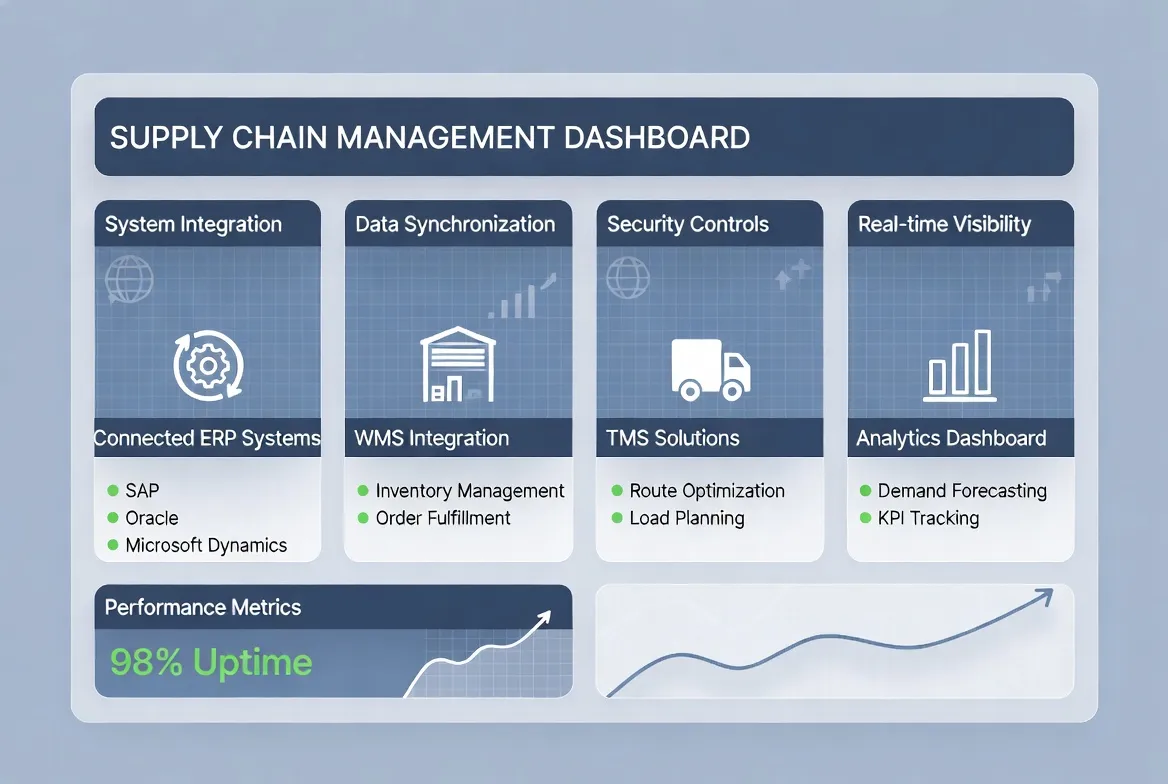
Integration with ERP, WMS, TMS, and external platforms
API and EDI connectivity
Seamless data exchange across systems
2. Real-Time Data Synchronization
Continuous updates across all connected systems
Consistent data across regions and stakeholders
3. Data Standardization
Unified data formats
Automated data validation and cleansing
Reduced data inconsistencies
4. Automation and Intelligence
AI-driven document recognition (OCR)
Automated data entry and processing
Workflow automation triggered by data events
5. Centralized Data Visibility
Unified dashboards
Real-time reporting and analytics
End-to-end operational transparency
6. Financial Data Integration
Linking operational data with billing and accounting
Automated invoicing and reconciliation
Profitability tracking
Benefits for Logistics Companies
1. Elimination of Data Silos
All data is centralized, improving accessibility and consistency.
2. Reduced Manual Work
Automation minimizes repetitive data entry and reduces errors.
3. Improved Operational Efficiency
Seamless data flow accelerates workflows and decision-making.
4. Enhanced Visibility
Real-time data provides full visibility into logistics operations.
5. Better Collaboration
Shared data enables smoother coordination between stakeholders.
6. Data-Driven Decision-Making
Accurate, real-time data supports strategic planning and optimization.
Best Practices / Use Cases
1. Integrating Freight Forwarding Systems
Connect multiple internal systems to create a unified operational environment.
2. Cross-Border eCommerce Logistics Integration
Link order management, warehousing, and delivery systems for seamless operations.
3. Multi-Partner Data Exchange
Enable real-time data sharing with carriers, agents, and suppliers.
4. Automating Document Processing
Use OCR and AI tools to extract and process logistics data efficiently.
5. Building a Digital Logistics Ecosystem
Create a connected network of systems and partners for scalable operations.
Conclusion
Cross-border logistics platforms for global logistics data integration are critical for managing the complexity of modern international logistics operations. By connecting disparate systems and standardizing data, these platforms enable logistics companies to achieve greater efficiency, visibility, and control.
As logistics networks become increasingly interconnected, the ability to integrate data seamlessly across systems is a key factor for operational success and scalability.
Frequently Asked Questions
1. What is logistics data integration?
Logistics data integration refers to connecting and synchronizing data across multiple systems and stakeholders involved in logistics operations.
2. How do logistics platforms integrate data?
They use APIs, EDI, and data processing tools to collect, standardize, and synchronize data from various sources.
3. Why is data integration important in cross-border logistics?
It eliminates data silos, improves visibility, and enables efficient coordination across global operations.
4. What are the key features of data integration platforms?
Key features include multi-system integration, real-time synchronization, data standardization, and automation.
5. Who benefits from logistics data integration platforms?
Freight forwarders, 3PL providers, and cross-border eCommerce logistics companies.
About WallTech
WallTech provides digital logistics solutions that enable seamless global logistics data integration through unified platforms connecting multiple systems, stakeholders, and operational processes. By leveraging technologies such as API integration, EDI connectivity, and AI-driven data recognition, WallTech helps logistics companies eliminate data silos and achieve real-time data synchronization. Its solutions also integrate operational and financial workflows, allowing businesses to improve efficiency, enhance visibility, and build scalable, data-driven logistics ecosystems.
If you're exploring ways to improve your logistics operations, feel free to connect with us to learn more about our solutions and system capabilities.