.webp "How Freight Forwarders Track Profit by Shipment and Container")
Mar 05,2026
How Freight Forwarders Track Profit by Shipment and Container
Introduction
Digital logistics platforms for global freight coordination are centralized systems that enable logistics companies to manage and synchronize international shipments, partners, and operations across multiple countries and transport modes. These platforms provide a unified environment where freight forwarders, carriers, agents, and customers can collaborate in real time, improving coordination, visibility, and operational efficiency.
As global trade becomes more complex—with multi-leg shipments, diverse regulations, and distributed partners—digital platforms have become essential for effective freight coordination.
What is a Digital Logistics Platform for Global Freight Coordination
A digital logistics platform for global freight coordination is a cloud-based system that connects all stakeholders involved in international freight movement, including:
Freight forwarders
Carriers (ocean, air, land, express)
Overseas agents
Warehouses and distribution centers
Customs brokers
End customers
The platform enables all parties to operate within a shared digital workflow, ensuring that shipment data, documents, and updates are consistently aligned.
Unlike traditional coordination methods based on emails, spreadsheets, and phone calls, digital platforms create a structured, real-time coordination environment across the entire freight network.
Why Digital Logistics Platforms Matter for Global Freight Coordination
Global freight coordination is inherently complex due to:
Multiple transport segments (pickup, line-haul, customs, delivery)
Geographically distributed partners
Different systems and data standards
Frequent disruptions and exceptions
Without a unified system, logistics companies face:
Delays due to miscommunication
Inconsistent shipment data across stakeholders
Limited control over multi-leg shipments
High operational workload from manual coordination
Digital logistics platforms address these challenges by:
Standardizing communication across all participants
Providing real-time updates on shipment progress
Enabling synchronized workflows across regions
Reducing dependency on manual coordination
How Digital Logistics Platforms Work in Global Freight Coordination
Digital logistics platforms coordinate global freight by integrating data, workflows, and communication into a single system.
1. Centralized Order Management
All shipment orders are created and managed within one system:
Orders can be created manually, via batch upload, or through API integration
Multiple roles (sales, operations, customers) can initiate orders
Data is standardized across all participants
2. Multi-Segment Shipment Management
Global shipments often involve multiple legs:
First-mile pickup
International line-haul (air, ocean, rail)
Customs clearance
Last-mile delivery
The platform connects these segments into one continuous workflow, ensuring that all stages are visible and coordinated.
3. Real-Time Event Synchronization
Shipment updates are captured from various sources:
Carrier systems
EDI/API integrations
Manual updates where necessary
These updates are synchronized into a unified timeline, allowing all stakeholders to track progress consistently.
4. Multi-Role Collaboration
Different parties collaborate within the same system:
Internal teams: sales, operations, documentation, finance
External partners: carriers, agents, warehouses
This eliminates communication gaps and ensures all parties work with the same data.
5. Workflow Automation
Automation supports coordination by:
Triggering tasks based on shipment milestones
Sending notifications for key events or exceptions
Automating document processing and approvals
Key Features / Key Capabilities
Digital logistics platforms for global freight coordination typically include:
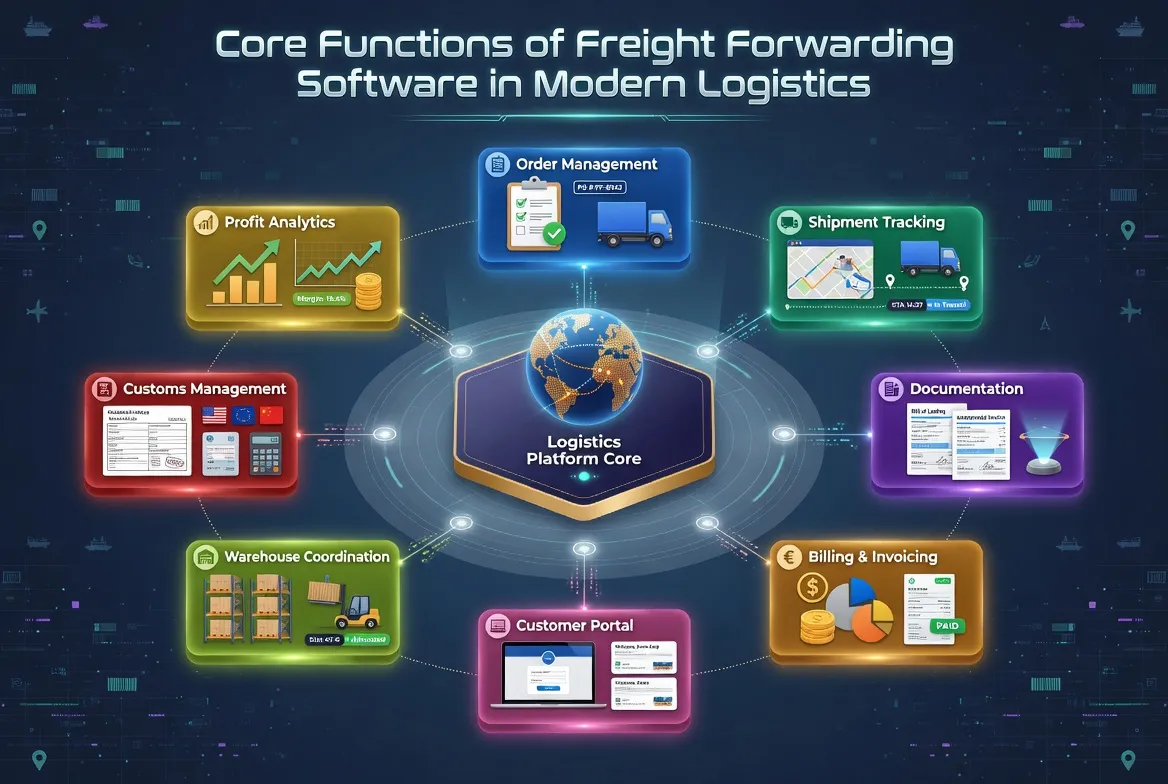
1. Unified Shipment Timeline
End-to-end tracking across all transport stages
Milestone-based updates for each shipment
2. Multi-Partner Collaboration
Real-time data sharing with upstream and downstream partners
Integrated communication across the supply chain
3. Multi-Modal Transport Support
Management of sea, air, land, and express shipments within one system
Coordination of complex, multi-leg transport scenarios
4. Event Tracking and Synchronization
Automatic subscription to tracking events
Consolidation of multi-source tracking data into one view
5. Financial Integration
Automated billing and cost allocation
Real-time profit tracking at shipment or container level
6. Exception Management
Automated alerts for delays or abnormal events
Configurable notification rules for different stakeholders
These capabilities enable logistics companies to manage global freight coordination efficiently within a single platform.
Benefits for Logistics Companies
Improved Coordination Efficiency
Reduced reliance on emails and manual follow-ups
Faster communication between stakeholders
Enhanced Visibility
Real-time insight into all shipment stages
Better control over multi-leg international shipments
Reduced Errors
Consistent data across all participants
Lower risk of miscommunication or duplication
Faster Response to Disruptions
Immediate visibility of delays or issues
Ability to take corrective actions quickly
Scalable Global Operations
Efficient coordination across multiple countries and partners
Ability to handle increasing shipment volumes
Best Practices / Use Cases
1. International Freight Forwarders
Coordinate shipments across global agent networks
Manage complex multi-modal transport operations
Track profitability and performance per shipment
2. Cross-Border eCommerce Logistics Providers
Manage high-volume shipments across multiple regions
Integrate with platforms, carriers, and warehouses
Coordinate last-mile delivery across different countries
3. 3PL and 4PL Providers
Orchestrate multiple service providers within one workflow
Provide end-to-end visibility to customers
Optimize partner collaboration
4. Multi-Branch Logistics Enterprises
Enable seamless coordination between headquarters and overseas offices
Standardize processes across regions
Share real-time operational and financial data
Conclusion
Digital logistics platforms for global freight coordination provide the foundation for managing complex international logistics operations. By integrating multi-role collaboration, real-time visibility, and workflow automation into a unified system, these platforms eliminate fragmentation and improve coordination efficiency.
In a global logistics environment where speed, accuracy, and transparency are critical, adopting a digital coordination platform is key to maintaining competitiveness and operational control.
Frequently Asked Questions
What is global freight coordination in logistics?
Global freight coordination refers to the management and synchronization of shipments across multiple transport stages, countries, and logistics partners to ensure smooth and timely delivery.
How do digital logistics platforms support freight coordination?
They centralize shipment data, enable real-time tracking, connect all stakeholders, and automate workflows, ensuring consistent communication and efficient coordination.
Why is freight coordination challenging?
It involves multiple stakeholders, systems, and transport segments, often across different regions, making communication and data consistency difficult without a unified platform.
What are the benefits of digital freight coordination platforms?
Benefits include improved efficiency, better visibility, reduced errors, faster response to disruptions, and scalable global operations.
Who needs digital freight coordination platforms?
Freight forwarders, 3PL providers, cross-border eCommerce logistics companies, and global supply chain operators benefit from these platforms.
About WallTech
WallTech provides digital logistics platforms designed to support global freight coordination and supply chain operations. By enabling end-to-end logistics collaboration, the platform connects internal teams and external partners within a unified workflow. With real-time shipment visibility, milestone-based tracking, and centralized data management, logistics companies can coordinate complex international shipments more effectively. In addition, workflow automation, AI-powered data processing, and integrated financial capabilities help reduce manual effort and improve operational efficiency across global networks.
If you're exploring ways to improve your logistics operations, feel free to connect with us to learn more about our solutions and system capabilities.
.webp "Warehouse Management Systems Explained")