
Apr 20,2026
Logistics Software for Cross-Border Fulfillment Companies
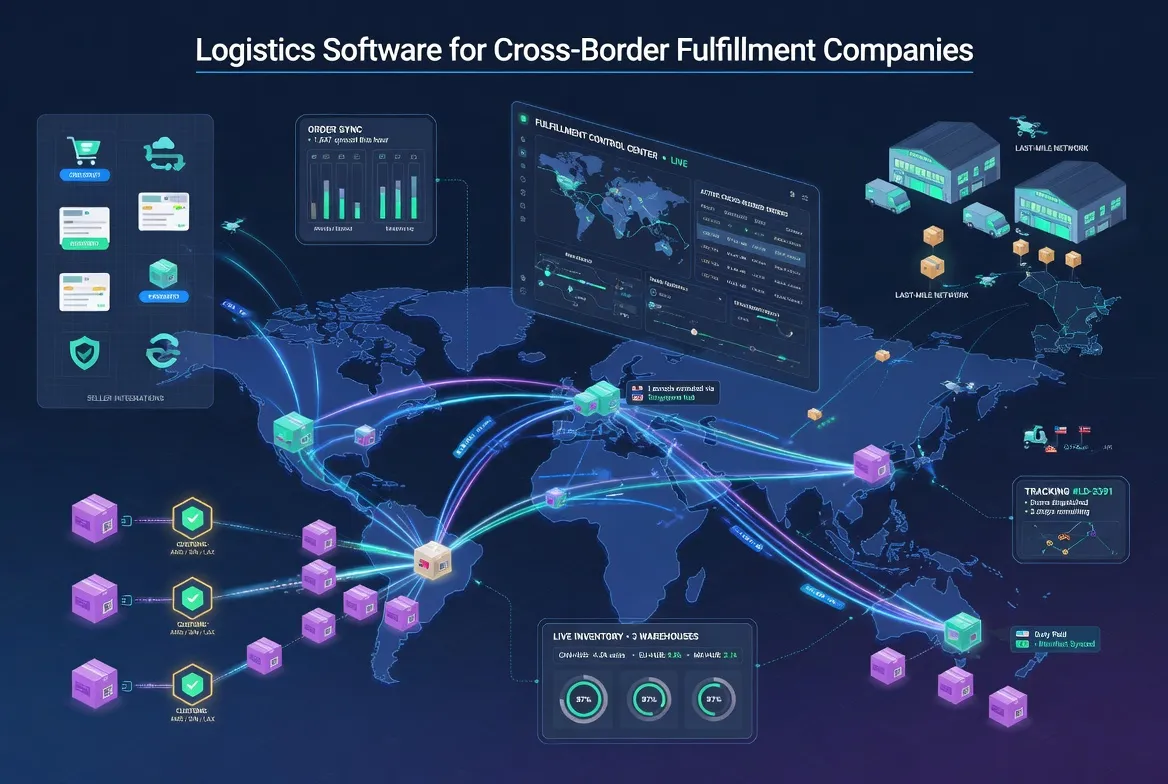
A cross-border parcel management system is a digital logistics platform designed to manage international small parcel shipments from order creation to final delivery. It supports route selection, label generation, customs coordination, tracking synchronization, billing, and performance monitoring across global delivery networks.
Why Is Cross-Border Parcel Management Complex?
Unlike traditional freight forwarding, cross-border parcel logistics involves:
High shipment volumes
Small parcel size and weight variability
Multiple last-mile carriers
Complex customs requirements
Dynamic pricing structures
Strict delivery time expectations
Managing these processes manually or across disconnected systems increases operational risk and reduces efficiency.
A cross-border parcel management system standardizes and automates these workflows.
Core Functions of a Cross-Border Parcel Management System
A modern system typically includes:
1️⃣ Order Management
Support multiple order input methods:
API integration with eCommerce platforms
ERP synchronization
Bulk order upload
Manual entry
This ensures seamless order capture from various sales channels.
2️⃣ Intelligent Routing Rules
Automatically assign the most suitable delivery service based on:
Destination country
Weight and dimensions
Value of goods
Battery or restricted goods conditions
Cost and delivery time
This reduces manual carrier selection and improves delivery efficiency.
3️⃣ Label & Waybill Generation
Generate:
Last-mile carrier labels
Internal tracking numbers
Relabeling for different transport segments
This ensures compliance with carrier and customs requirements.
4️⃣ End-to-End Tracking Visibility
Provide complete shipment tracking across:
Operation hubs
Line-haul segments
Customs clearance
Final-mile delivery
Tracking events can be synchronized automatically from integrated carriers.
5️⃣ Customs & Clearance Coordination
Maintain key shipment information required for customs processing, reducing clearance delays.
6️⃣ Billing & Financial Management
Automate:
Freight cost calculation
Surcharges
Customer billing
Credit control
Parcel-level profitability analysis
This supports scalable small-parcel operations.
How Is It Different from a Traditional Freight System?
A traditional freight forwarding system is optimized for containerized or bulk shipments.
A cross-border parcel management system is designed for:
High-frequency, low-weight shipments
Automated routing logic
Carrier API integration
Parcel-level cost accounting
Real-time label printing
It is built for speed, automation, and high-volume processing.
Who Uses a Cross-Border Parcel Management System?
Typical users include:
Cross-border eCommerce logistics providers
Parcel consolidators
Last-mile delivery integrators
International postal consolidators
Logistics companies serving online sellers
Businesses handling thousands to millions of parcels annually rely on automation to maintain operational efficiency.
Business Benefits
Implementing a cross-border parcel management system can:
Reduce manual processing time
Improve delivery route optimization
Minimize labeling errors
Increase tracking transparency
Strengthen customer satisfaction
Improve parcel-level profit control
It enables scalable global parcel fulfillment in competitive eCommerce markets.
Conclusion
A cross-border parcel management system is a specialized logistics platform for managing international small parcel shipments. By automating routing, tracking, billing, and customs coordination, it supports efficient, high-volume cross-border eCommerce logistics operations.