
May 11,2026
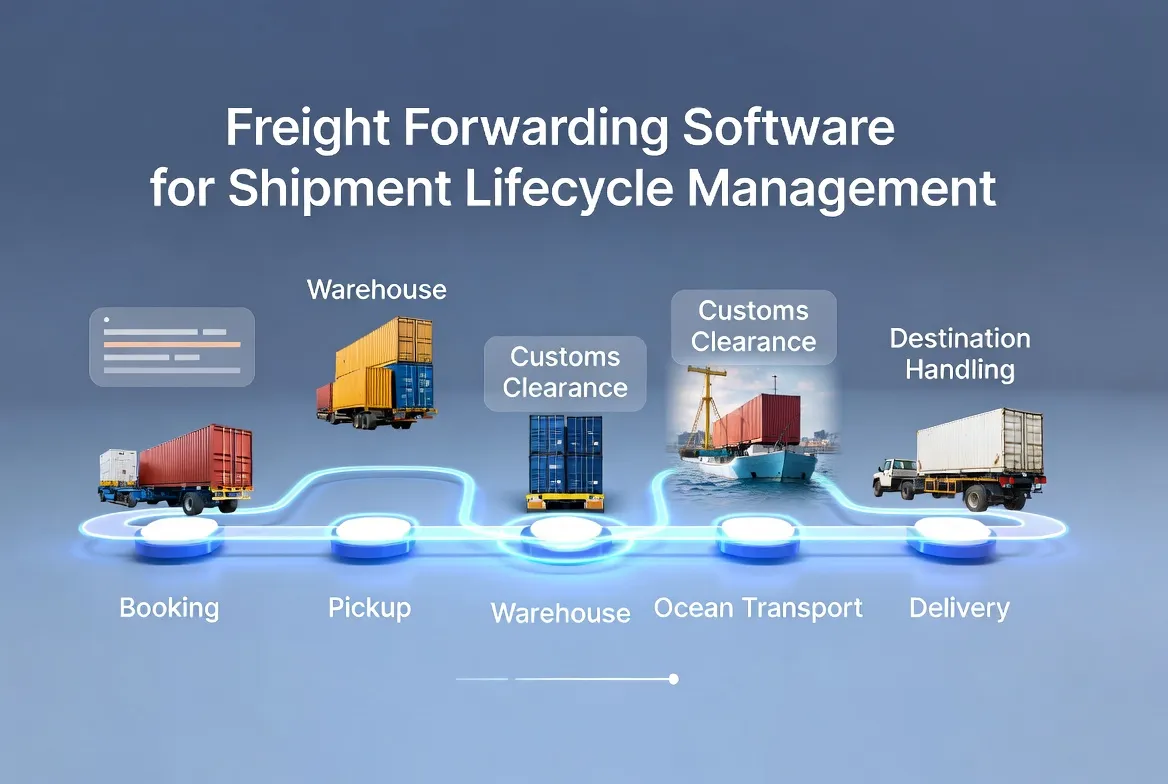
Freight Forwarding Software for Shipment Lifecycle Management
Introduction
Recent disruptions in the Red Sea have once again forced major ocean carriers—including Maersk—to adjust their Suez Canal transit strategies, alternating between partial resumptions and renewed diversions via the Cape of Good Hope. This stop-start pattern is creating significant uncertainty in global shipping schedules.
For freight forwarders and supply chain operators, this Red Sea shipping disruption is no longer a short-term event. It is reshaping global lead times, driving volatile surcharges, and forcing companies to rethink inventory buffers and routing strategies in 2026.
What happened in the logistics industry
Over the past two weeks, renewed geopolitical risks in the Red Sea have led carriers to reassess transit safety through the Suez Canal.
Key developments include:
Major carriers temporarily resuming Suez routes, then suspending again due to security concerns
Widespread rerouting of vessels around the Cape of Good Hope
Transit times increasing by 10–20 days on Asia–Europe lanes
Capacity tightening due to longer vessel cycles
Introduction or adjustment of war risk surcharges and congestion-related fees
This inconsistency has created a “non-linear” shipping environment—where schedules cannot be reliably forecasted using traditional planning models.
Why this matters for global logistics companies
For freight forwarders, 3PLs, and cross-border logistics providers, the implications are immediate and structural:
1. Lead time unpredictability
ETAs are no longer stable. A single shipment may experience multiple revisions depending on routing changes mid-transit.
2. Rising operational costs
Cape rerouting significantly increases fuel consumption and vessel utilization, driving:
Ocean freight rate volatility
Emergency surcharges
Higher inland coordination costs
3. Inventory pressure
Shippers must increase safety stock levels to buffer against delays, impacting:
Working capital
Warehouse capacity
Inventory turnover rates
4. Customer expectation gaps
End customers still expect accurate delivery timelines, creating pressure on forwarders to provide reliable updates despite uncertainty.
Key challenges exposed by this event
Operational inefficiencies
Manual planning processes cannot keep up with rapidly changing routing decisions. Teams are forced into reactive firefighting rather than proactive management.
Visibility gaps
Shipment data often remains fragmented across:
Carrier systems
Internal spreadsheets
Partner communications
This leads to delayed awareness of disruptions.
Coordination issues
Multiple stakeholders—carriers, forwarders, trucking providers, warehouses—must adjust simultaneously, but lack synchronized systems.
Cost control problems
Surcharges and cost fluctuations are difficult to track and allocate accurately, leading to margin leakage.
How modern logistics platforms help address these challenges
The Red Sea disruption highlights the critical role of digital freight systems and control-tower platforms in managing uncertainty.
End-to-end shipment visibility
Modern platforms consolidate data across ocean, inland, and last-mile legs into a unified timeline. This enables teams to:
Track real-time shipment status across all transport segments
Identify delays as soon as they occur
Maintain a single source of truth across stakeholders
As seen in integrated logistics systems, multi-segment tracking allows synchronized visibility even when routes shift dynamically .
Predictive ETA and exception management
Advanced platforms leverage historical data and AI models to:
Recalculate ETAs dynamically based on rerouting scenarios
Trigger automated alerts when milestones are missed
Recommend alternative routing or operational adjustments
This shifts operations from reactive updates to proactive exception handling.
Multi-role collaboration across global teams
Disruptions require coordination across departments:
Sales updating customers
Operations adjusting bookings
Finance recalculating costs
Modern systems enable all roles to collaborate within a shared workflow, ensuring that changes are reflected instantly across the organization.
API/EDI integration for real-time synchronization
By integrating directly with:
Ocean carriers
Port systems
ERP and finance platforms
Logistics software ensures that:
Booking updates
Surcharge changes
Shipment milestones
are synchronized automatically, eliminating manual re-entry and reducing errors.
Cost and surcharge management automation
Digital platforms allow:
Automated allocation of additional surcharges
Real-time profitability tracking per shipment
Scenario-based cost simulations
This ensures financial control even under volatile conditions.
AI, OCR, and RPA in disruption handling
Emerging technologies further enhance resilience:
OCR extracts rate and surcharge data from carrier documents
RPA automates repetitive tracking updates and data entry
AI assistants support rapid decision-making and reporting
These capabilities significantly reduce manual workload and improve response speed in crisis scenarios .
Strategic takeaways for logistics companies
1. Shift from static planning to dynamic orchestration
Traditional fixed-route planning is no longer viable. Companies must adopt systems that support real-time adjustments.
2. Build buffer strategies with data support
Inventory buffers should be optimized using predictive analytics rather than conservative overstocking.
3. Strengthen carrier and partner integration
Closer system integration ensures faster response to disruptions and better coordination across the supply chain.
4. Invest in visibility as a core capability
End-to-end visibility is no longer optional—it is foundational for maintaining service reliability.
5. Automate exception handling
Manual processes cannot scale under volatility. Automation is essential for maintaining operational efficiency.
Conclusion
The ongoing Red Sea disruptions and shifting Suez Canal strategies mark a turning point in global logistics. Schedule reliability is no longer guaranteed, and companies must operate in an environment defined by uncertainty.
In this new reality, success depends on the ability to see, decide, and act faster than disruption unfolds—a capability increasingly driven by digital logistics platforms and intelligent automation.
For companies looking to strengthen resilience and operational control under such volatility, exploring modern logistics technology solutions can provide a significant advantage—feel free to get in touch with WallTech to learn more about smart, integrated logistics systems.
FAQ
1. How does the Red Sea disruption affect global shipping routes?
It forces carriers to reroute via the Cape of Good Hope, increasing transit times and reducing available capacity.
2. Why are freight rates increasing during this disruption?
Longer routes increase fuel and operational costs, while reduced effective capacity drives rate volatility and surcharges.
3. How can logistics companies maintain service reliability?
By adopting digital platforms with real-time visibility, predictive ETAs, and automated exception management.
About WallTech
WallTech provides digital logistics solutions that support global trade compliance through structured workflows, centralized document management, and real-time shipment visibility. By integrating compliance checks into operational processes and enabling collaboration across teams and partners, WallTech helps logistics companies reduce risks, improve accuracy, and manage cross-border operations more efficiently.
If you're exploring ways to improve your logistics operations, feel free to connect with us to learn more about our solutions and system capabilities.
.webp "What Is an End-to-End Logistics Management Platform")